




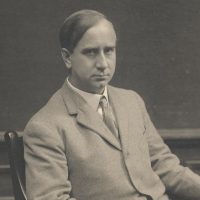
Painter Charles Webster Hawthorne played a pivotal role in shaping the Cape Cod art community in the early twentieth century. Raised in Maine, he later moved to New York to study drawing and painting at the National Academy of Design and the Art Students League, where he studied under William Merritt Chase. His early work shows the tonal influence of his teacher. Inspired by these ideas, Hawthorne moved to the small fishing town of Provincetown, Massachusetts, where he established the Cape Cod School of Art in 1899 and taught there every summer until his death.
In Provincetown, Hawthorne was equally drawn to the distinctive light of the coast. Best known as a figure painter, he explored these effects in watercolors such as Gray Day, Spring, Provincetown, using loose washes to capture a muted atmosphere, in contrast to the more structured surfaces of his works in oil. Hawthorne’s work is represented in the permanent collections of the Art Institute of Chicago, the Metropolitan Museum of Art in New York, and the Smithsonian American Art Museum.